My name is Pedro Laboy and I am a business strategist. My specialties are marketing and

branding. My tools of choice are technology, social media, and analytics. My name is

Pedro Laboy and I am a business strategist.

Categories

RSS Feeds

Posts Tagged ‘Analytics’

What is predictive analytics? This great presentation from 1to1 Media gives a great explanation.

How exactly does one estimate the reach of a blog placement?

Estimating the reach of a display (banner) ad is a straightforward process. We can tell how many times the ad was served, how many people interacted with it and how many of them clicked through.

For blogs, this task is bit more complex and at times not possible to estimate. First, a blog’s “media kit” only provides Monthly Unique Visitors (MUV). Second, there is no mechanism for tracking exactly how many people view the placement.

Some brands take a simplistic approach to estimating the reach of a blog placement. For example, some simply divide the MUVs for a blog by thirty days to get an estimate of how many visitors viewed a post when it was in the top spot on a blog. However, the daily number of visitors ebbs and flows–there be many unique visitors that frequent the site every day, but there may also be several days that do not fit a typical linear pattern.

For instance, let’s assume that a blog has 10 MUVs, and that they visit the site every time content gets posted. Even if brand’s content gets posted only once, you would still reach 10 MUVs.  If the visitors only read every other post, you would reach half. This is the reason why blogs do not give daily numbers.

Another approach would be to use a tool such as Quantcast to estimate daily visitors but given the example above it could lead erroneous assumptions. Furthermore, there are many external events that may affect a blog’s daily unique visitors.  Some events are known and anticipated. For luxury brands, it critical to secure placements during Fashion Week or on Oscar night and celebrities are dressed in designer labels—but a placement during Superbowl Sunday would likely fall flat. There are also unpredictable events that may cause certain days to have an abnormal number of visitors, whether it be higher or lower.

In my experience, the actual reach of a blog placement is closer to the monthly number than to the daily one.

In marketing, “What” and “How” you measure is a factor of defined goals and available data.

Defined Goals

Sometimes a marketer’s goal is to meet certain non-financial objectives such as increased awareness or customer registrations.  In these instances, these measures should be referred to as Return on Objectives (ROO) rather than Return on Investment (ROI)—which is a finance term that implies a financial return on a specific investment.  Of course, all marketing activities should eventually be linked to some form of ROI measurement.  The question is which kind.  Is your stated financial goal to increase stock price? Profits? Quarterly sales? Cash flow? Customer value? EVA? Etc. It would be ideal if one could opt for all of the above.  It is important to keep in mind, however, that these are realized over different life cycles and measured with different methodologies.  Furthermore, using more than one or two ROI benchmarks often leads to organizational misalignment and loss of strategic focus. Achieving organizational alignment is one of the most important steps towards creating marketing that can be measured. Marketers should focus on developing the that services span the mediation and group discovery efforts that lead to alignment within an organization, as well as the more quantitative back end measurement strategies and implementations. At any rate, once goals are clearly articulated and agreed upon, the entire marketing measurement challenge becomes clarified.

Available Data

A quantitative model is only as good as its data input.  We are all familiar with the phrase “garbage in, garbage out.” A metrics model must be appropriate for the kind of data available.  For example, if your company has extensive customer data collected over long periods of time, a comprehensive ROI model can be put in place.  However, if these data are not available a different, less precise, model would have to be developed.  Even with extensive access to customer and market data, it is important to qualify the quality of these data.  A simple ROI formula that can be applied to all businesses across all industries does not exist.  Metrics models must be tailored to each corporation’s business model and corporate strategy to deliver information that is relevant to the defined goals.  Such models can and should be developed.

Whether you are trying to determine customer lifetime value or put in place a media mix model, marketing measurement can often be a complex and daunting task.  There are, however, some steps marketers can take to improve the efficiency and effectiveness of their marketing metrics programs

Alignment – In my experience, this is one of the biggest challenges to putting in place an effective measured approach to marketing. That is, lack of alignment behind the need to weave metrics into marketing initiatives. Furthermore, lack of alignment among key departments—finance, technology, sales and marketing—on how measurement initiatives should be deployed and who is responsible for what.

Defining Success – How do we define success? What are the right benchmarks? Should we look at short-term gains in sales or an increase in customer lifetime value? Do we confuse efficiency with effectiveness, and vise-versa? In our industry, talk of ROI or ROMI is ubiquitous. However, marketers manipulate and redefining this term to demonstrate success where none exists.

Data – Data gathering can undoubtedly be a daunting task—tracking codes, DNIs, unique 800 numbers, surveys, POS results, etc. Even if there is a mechanism is place to gather both customer and marketing data, there must be a sufficient sample and enough observations. Furthermore, in order to draw actionable insights, data must be collected, cleansed and mined in a timely manner.

Technology – Even if the will to embrace metrics is there, must companies are constrained by their technology infrastructure. This is specially the case for SMBs. Technology consulting, as it relates to marketing measurement, could be one of the services offered by the new agency.

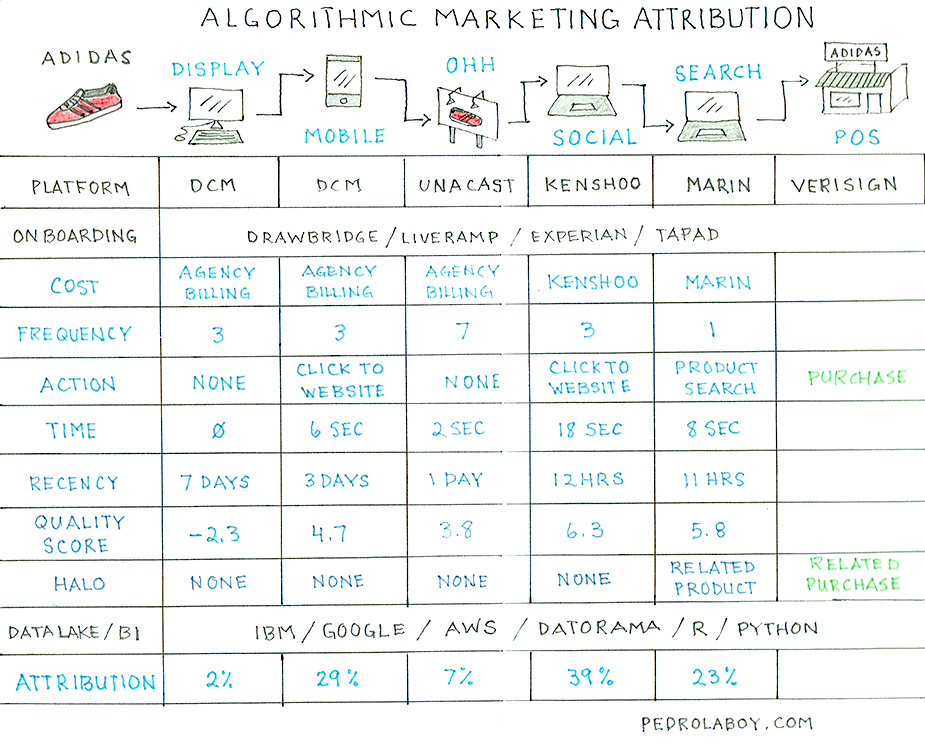
Attribution – This is a challenge that we faced when working with Dell and other companies. Today’s multi-channel marketing initiatives can be fairly complex—often reaching consumers simultaneously through many points-of-touch. How exactly do we know which ad pushed a consumer from consideration to purchase? We used a variety of methods to deal with the problem of attribution: from the often overused fairness approach to the last touch-point approach to developing RFM models that helped weight results.

Lag – Arguably, most marketing vehicles have a short-term effect. However, there is a residual value that should be taken into account. Often consumers get sold on products and services through long-term brand building initiatives that can be hard to track and measure. How do we account for this lag? As challenging as it may be, it cannot be ignored. Metrics strategies must include long-term equity building initiatives into ROI models.

Methodology – Marketers tend to apply simplistic models to complex measurement challenges. Statistical methods will vary depending on goals defined and data available. For example, media mix models will often involve some type of multivariate regression analysis—linear or logistic. These multivariate analysis should look at a number of dependent and independent variables. For instance, for certain initiatives it might make sense to go beyond the obvious  look at the weather or search engine volume or the consumer confidence index. Furthermore, cost of creative production should be included in these models–but often is not. Ultimately, methodologies used are a factor of data available and measurement goals.

Staff – In my experience, the staff needed to provide marketing metrics services to clients cannot have a background on data analytics alone. It is important to also hire staff with an in-depth understanding of how business models work (i.e. MBAs, etc). Furthermore, it is important for staff to be familiar with account planning techniques as well as advertising models.

This amazing graphic from Information Is Beutiful reinforces what we have already learned in Anthropology 101. That is, women’s social and communication skills are more advanced that those of men. From a marketing perspective, these data should be taken into account when crafting channel strategies that target women. By the way, the data for this graphic were obtained from Google’s Ad Planner–a great source of publicly available web data.

According to a recent eMarketer survey, marketers fail to embrace the use of web analytics for a number of reasons. The top reason given is the lack of integration with other marketing solutions. Which I will admit can at times be challenging—but not totally insurmountable. However, the other reasons listed should not be an obstacle for most marketers. No budget is too small for Google Analytics. Furthermore, basic math skills and a few hours of training is all that is required to turn data into valuable actionable insights.

So here is a link where you can sign up, at no cost, for Google Analytics. Here is a link to post that lists more than 40 free Google Analytics plug-ins and resources. Finally, here are five videos that will help you master both basic and advanced features of Google Analytics. If this is still not enough, contact me so we can discuss a solution that will fit you needs.

1. Set Up


2. Basic Analytics


3. AdWords and Google Analytics


4. Segmentation


5. Motion Charts

The Internet has given both consumers and businesses access to vast amounts of information.  Easily organizing and understanding relationships among different sources and kinds of the data is another manner all together.  Over the last few of years several websites have used “Tag Clouds” to help their users navigate information in their sites.   A Tag Cloud is a text-based depiction of tags across a body of content to show frequency of tag usage and enable topic browsing. In general, the more commonly used tags are displayed with a larger font or stronger emphasis. Each term in the tag cloud is a link to the collection of items that have that tag. Digg, the internet news site, has taken Tag Clouds to a new level by developing what they call Swarms, Stacks and other forms of information “clouds.”  Examples of these can be found at labs.digg.com.

Stack

Swarm

Bigspy

Arc


Pics

Given the sheer volume of marketing data out there, you can’t afford not to have a data-mining strategy. Data are at the core of today’s technology revolution. In 2007, some 500 billion gigabytes of digital data were created every day. That is equivalent to 50 million times the contents of the Library of Congress. Internet devices, mobile phones, network and satellite television, traditional and satellite radio and other digital media make possible more targeted, frequent contact with the masses. At the same time, whether collected at the cash register or through the Internet, companies are amassing troves of consumer data. This demographic, geographic and psychographic data should be fully exploited to help companies predict consumer behavior and preferences.

The collection and use of customer data to optimize marketing efforts are nothing new. In the 1920s, General Motors discovered that loyalty among Ford vehicle owners was very low—a Ford driver was not likely to purchase his second vehicle from Ford. So General Motors began surveying these drivers to collect data and develop insights into customer preferences. These insights were then used to develop marketing campaigns that targeted Ford vehicle owners. Today, data-centric companies like online retailer Amazon.com in the U.S. and brick and mortar retailer Tesco in the U.K. rely on mathematical modeling to ensure that the right products are offered to the right consumers at the right time. For instance, Tesco’s deployment of its loyalty-card program and the resulting data gathered from its users are credited with helping Tesco fight off Wal-Mart’s entrance into the U.K. market. The data collected is used to tailor marketing programs for its customers. For example, Tesco customers who buy diapers for the first time receive offers for baby wipes, toys and beer—as data analysis show that new fathers are more likely to drink at home. Tesco’s loyalty-card program is so successful that major consumer products companies buy reports based on data collected and analyzed by Tesco.

Companies are also leveraging technology and analytics to target, track and optimize marketing campaigns. For example, Dell uses campaign management tracking software to track near real-time responses to its online, direct-mail and print advertising. Analysis of the data collected allows Dell to continuously optimize its marketing efforts, resulting in a higher return of marketing dollars invested.

By no means are companies the only ones benefiting from today’s data-rich world. Consumers have more data and information at their fingertips than ever before. They are just a few clicks away from the best mortgage rates or the entire collection of the Library of Congress. The last few years have seen the proliferation of Internet companies that provide pricing and product information for millions of items and services in a fraction of a second. Without leaving the comfort of a chair, a buyer can determine which companies offer the lowest prices, free shipping, etc. However, unbeknownst to most consumers, the data flow is often two-way. Most of these companies collect data on site visitors for their own use. Google, Yahoo! and MSN, for example, keep a record of every search ever made through their search engines. The data collected includes the IP address of the person doing the search, keywords entered, results returned by the search engine and websites visited. Other sites, like pricegrabber.com and pricescan.com, play both sides of the fence. They provide product data to consumers and consumer data to companies—by tracking consumer shopping behavior on their websites.

As marketers continue to embrace new technologies and channels such as mobile and IPTV, they will be inundated with even more data. The industry leaders of the future will be those who are able to collect and mine this data to understand and predict individual consumer behavior. However, it seems that many companies still have a long way to go before they fully embrace analytics, CRM techniques and other measurable marketing strategies. In a summer 2008 survey conducted by Epsilon, only 30% of CMO’s said they agree with the statement “You use sophisticated modeling tools to analyze existing customer data (behavioral, preference and demographic).‘’ And this in spite of the fact that almost 70% of CMO’s are generating more data than ever before by increasing their spend on interactive advertising.