
Stop Betting Your AI Strategy on a Model

June 16, 2026 7 mins to read
Share

Here is what separates the companies getting real value from AI from the ones still running pilots. They own the orchestration layer, the system that directs the AI model and connects it to everything else. The model itself they treat as a swappable part.

Advertising just produced a clean example of this, and the lesson reaches well beyond marketing into any business adopting AI.

The example comes from Innovid, an ad serving and measurement platform, meaning the technology that delivers digital ads and tracks how they perform. Innovid is owned by Mediaocean, one of the largest software companies in advertising, which runs much of the financial and operational plumbing the industry uses to plan, buy, and bill media. Innovid recently launched an AI system called NIVO and reported cutting campaign launch time by up to 90 percent in early pilots with brands including FanDuel and Paddy Power. The number drew the headlines. The architecture underneath it is the part worth studying.

So let me walk through who built it, what it is, how it works, why they made these choices, and what it means for any leader thinking about their own AI stack.

Article content

Who built it, and why that matters

What makes NIVO work is everything Innovid already had before it added any AI. Innovid took its current shape when two established ad tech companies combined, Innovid and Flashtalking, both of which had spent years building the systems that serve and track digital ads. The merged company then became part of Mediaocean.

That gave NIVO a foundation most AI tools lack. It runs on a system that already touches trillions of ad impressions a year with independently accredited measurement, wired into Prisma, the tool much of the industry uses to plan and buy media, and Protected, Mediaocean’s verification and brand safety system. Innovid did not start NIVO from a blank page. It started from the pipes the industry already runs on.
Marketers are trying to run new AI on old infrastructure. NIVO is the attempt to fix the infrastructure, not bolt a chatbot onto it.

What NIVO actually is

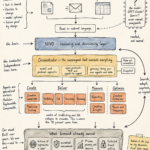
NIVO is not a model. It is not a single agent. It is an intelligence layer that sits inside the Innovid platform and powers a set of specialized agents.

The architecture has three parts, and Innovid’s own framing is a clean division of labor. NIVO thinks. Orchestrator connects. The agents act.

NIVO is the reasoning and decisioning layer. Orchestrator is the superagent, the conductor that coordinates the other agents and links them out to media platforms, planning, billing, data, and analytics systems. The agents are the workers, each automating one narrow task.

There are ten named agents today, grouped around four stages of the advertising lifecycle. In the create stage, a Creative Generator agent produces and adapts creative, and a Predictive Scoring agent forecasts which versions will perform before any budget is spent. In the deliver stage, a Trafficking agent sets the campaign up to run across each platform, a QA agent catches errors before launch, a Decisioning agent turns strategy into dynamic execution, and a Taxonomy agent standardizes naming so the data stays clean. In the measure stage, a Reporting agent answers performance questions across channels and a Creative Insights agent surfaces asset-level findings. In the optimize stage, a Creative Optimizer agent improves campaigns in flight and a Reach and Frequency agent finds overexposed and underexposed households in real time.

How it works in practice

The input is a brief, an email, or a spreadsheet. NIVO reads it through natural language, so the starting point is a normal work artifact rather than a manual setup screen. The Decisioning and Trafficking agents translate that intent into a campaign that is built and ready to traffic. The QA agent checks it before it goes live. Once the campaign is running, the measure agents answer questions in plain language and the optimize agents reallocate budget, audience, and messaging on the fly. Orchestrator runs this as a loop, so the system launches, adapts, and improves without a person rebuilding each step by hand.

The compression happens in the deliver stage, where weeks of trafficking and quality checks collapse into minutes. That is where the time went, and it came back.

Two more design details matter. First, interoperability. By Innovid’s own account, Orchestrator is built to be model and protocol agnostic. It supports open agent protocols, including MCP, an emerging standard that lets AI systems share tools and context across vendors, and agent-to-agent communication that lets different companies’ agents work together. It also includes a gateway so clients can plug in their own agents and tools. You can bring your own data, models, and agents into the system rather than accept a closed set. It already connects into places marketers work, including Meta ad connectors and Snapchat workflows.

Second, control. NIVO keeps a human in the loop on high-impact decisions. Innovid states that client data is never used to train external AI models, is not sold for third-party AI development, and that the AI operates their own services rather than feeding someone else’s. For regulated categories and brand-sensitive work, that posture is the difference between a tool teams can use and one legal will block.

Now the detail almost nobody mentions. Read every NIVO page and you will not find GPT, Claude, or Gemini named anywhere. Innovid does not tell you which model is inside. That is not an oversight. It is the strategy.

Why they built it this way

Innovid is betting that the model is the least durable part of the stack.

Models change every few months. Prices move, a flagship gets leapfrogged, a cheaper competitor matches it. If you anchor your product to one model name, your product inherits all of that volatility. So Innovid anchored to the things that do not churn. The impression data. The measurement accreditation. The execution pipes. The orchestration logic. The model became a swappable part feeding a system built on assets Innovid owns.

The positioning follows from the architecture. Innovid sells itself as independent and media neutral, in contrast to platforms whose AI quietly favors their own inventory. That claim only holds if the intelligence layer is not married to a single vendor, model or media owner. Model agnosticism is not a tech preference here. It is the business model.

So what, for your team

This is the lesson worth taking, and it reaches past advertising into any business adopting AI.

The model you license is rented. The data, the workflows, and the orchestration you build are owned. The companies getting durable value from AI are putting their energy into the owned layer, and treating the model as a dial they can turn.

Owning your router does not mean building a foundation model. For almost everyone that is a waste of money and years. It means three concrete things. Keep model choice a setting you can change without rebuilding everything around it. Put real investment into your first-party data, your creative libraries, and the workflow logic that turns a brief into a live campaign. And hold the intelligence close to the systems you control, so you keep a say over how it behaves.

Look back at where Innovid’s 90 percent came from. Not a smarter model. Ownership of the data and the pipes the model runs through. A brand or agency that wires its entire operation to a single model name is building on land it rents, and it will spend next year pulling that wiring back out.

One honest caveat. These are early pilot numbers from the vendor, and Innovid says many of the agents are still in design partnership, alpha, or beta. Treat the figures as direction, not gospel. The architecture lesson holds regardless of how the rollout matures.

The model you run this quarter will not be the model you run a year from now. The real question is whether your AI strategy survives the swap. Does yours?

At Brand Nexus AI this is the work, helping marketing teams build the layer they own so the model stays a choice, not a dependency. Happy to compare notes if you are mapping your own stack.


Leave a comment

Your email address will not be published. Required fields are marked *