
The most important advertising surface of the next two years is a chat window. Snap, Meta, and Sephora have each shown a different shape of it inside the last six weeks.
Most marketing teams are still briefing for the old surface.
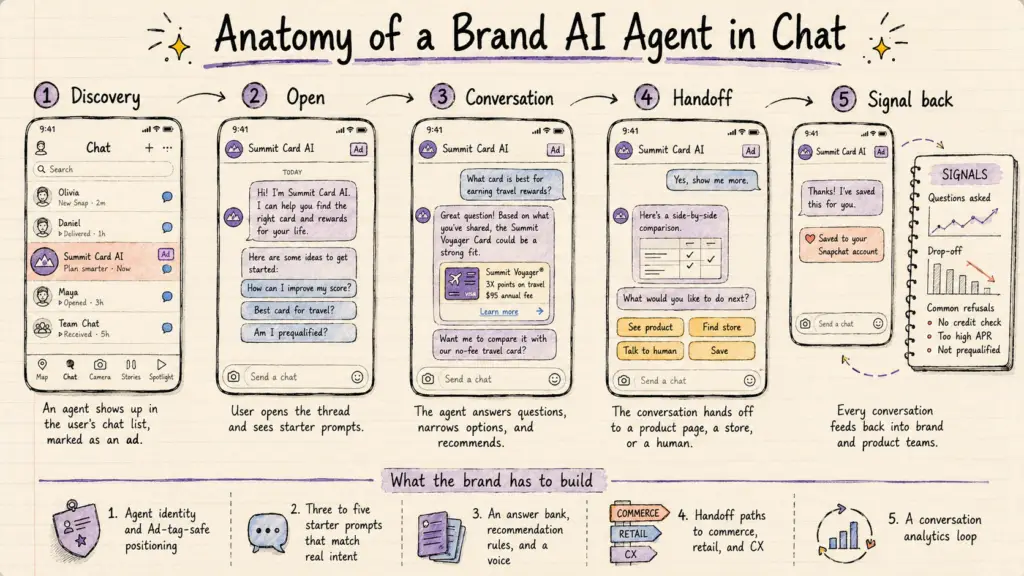
On April 28, Snap launched AI Sponsored Snaps in alpha. The format places a brand-built AI agent inside Snapchat’s main Chat tab, marked as an ad, so users can ask questions, get recommendations, and decide in real time. Experian is one of the early partners.
Two days later, on its Q1 2026 earnings call, Meta said business AIs now facilitate more than ten million conversations a week across WhatsApp and Messenger, up from about one million at the start of the year. That is a tenfold increase in a single quarter, with Latin America, Indonesia, and Asia Pacific leading the expansion.
A few weeks earlier, on March 24, Sephora launched an app inside ChatGPT. A shopper can type Sephora, help me find a foundation for dry skin, and the brand’s agent responds with personalized picks, drawing on the user’s Beauty Insider profile if they link the account. Future updates will let people complete a purchase without leaving the chat.
Three different surfaces. One shared move. The brand becomes a participant in a conversation the customer started, instead of an interruption between content pieces.
That is a different job for marketing. It also breaks most of the assets your team is set up to produce.
What chat actually demands
A static ad asks a customer to react in two seconds. A chat agent asks a customer to engage for two minutes. Different attention model, different craft.
In a static ad, you control everything. In a chat, the customer controls half of it. Your agent has to perform across hundreds of question paths it cannot pre-script, while staying on-brand and useful. That changes the brief in five specific ways.
Voice has to be codified, not implied. A thirty-second spot can carry tone through music, casting, and edit. An agent has none of those. The only thing it has is words on a screen, which means your voice guidelines need to specify cadence, formality, humor tolerance, and how the brand says no. Warm but confident will not survive contact with a real user.
You need an answer bank, not a script. Sephora’s agent works because it draws on product data, profile data, and review data. Without that backbone, the conversation collapses into either generic LLM responses or robotic FAQ behavior. Marketers used to briefing copywriters now need to brief knowledge engineers too.
Refusal rules are part of the asset list. The model will be asked things you do not want it to answer. Pricing on unreleased products. Comparisons with competitors. Medical, financial, or legal claims. Your guardrails need to be explicit, and your refusals need to sound like the brand, not like corporate legal.
Handoffs need a path. Snap’s agent can route to a product page or a human. Meta’s business AIs route to order tracking, scheduling, and store data. Sephora will eventually close a purchase inside ChatGPT. The handoff is where conversion lives. If you do not design it, the conversation goes nowhere.
Conversation analytics is the new media analytics. Every chat produces a record of what customers actually ask, where they drop off, and what objections they raise. That is the most useful brand signal a marketer has ever had access to. Most teams have no plan for what to do with it yet.
A cautionary tale before you go too fast
Klarna spent 2024 publicly celebrating an AI customer service agent that handled two-thirds of inquiries and matched human satisfaction. Then in 2025, the company quietly walked back the AI-only posture and re-hired humans for complex cases. The model occasionally gave confident-but-wrong answers about fees and policy, which in fintech is a compliance problem, not a CX problem.
The lesson is not that AI agents do not work. They do. The lesson is that the value depends on knowing where the agent ends and a human begins, and being honest about it from day one. The teams winning at this are designing the handoff first, not last.
The first move for your team
If you sit on a brand team or run an agency account and you do not have a live branded AI agent yet, do not start by buying a platform. Start by writing a one-page brief that answers four questions.
What three to five questions does a real customer want to ask your brand before buying, that they cannot get a good answer to anywhere else?
What does your brand sound like in a five-message back-and-forth, including a refusal?
What does the handoff look like when the customer wants to buy, return, complain, or talk to a human?
What signals will you measure that prove the agent is helping the brand, not just deflecting tickets?
Most teams cannot answer those four today. The ones that can will have a year of head start on every brief they touch.
There is a second move that matters as much as the first one. Pick a single category question your customers are already asking, in any channel, and treat that as the wedge. Sephora picked foundation matching. Snap’s early partner Experian is leaning into credit literacy. Pick the one where conversational depth actually adds value, not the one where a banner would already work.
Avoid building a general assistant first. General assistants are where most branded chat efforts have died for a decade. The format does not reward breadth, it rewards a useful, specific point of view delivered in the customer’s own words.
Where this leaves the CMO
Two budgets are about to converge. The media budget that paid for placements, and the CX or product budget that paid for the chat experience. They were separate because the surfaces were separate. Now they are the same surface.
The CMOs who notice this first will reorganize how their teams brief, build, and measure. The ones who do not will keep producing thirty-second spots for a feed that is quietly turning into a chat thread.
What is the first question a customer would ask your brand if you put a chat box on their phone tomorrow? Most teams cannot answer that yet. Start there.